




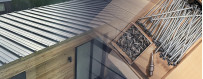
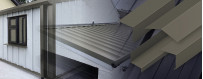

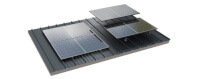
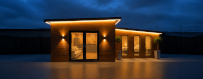
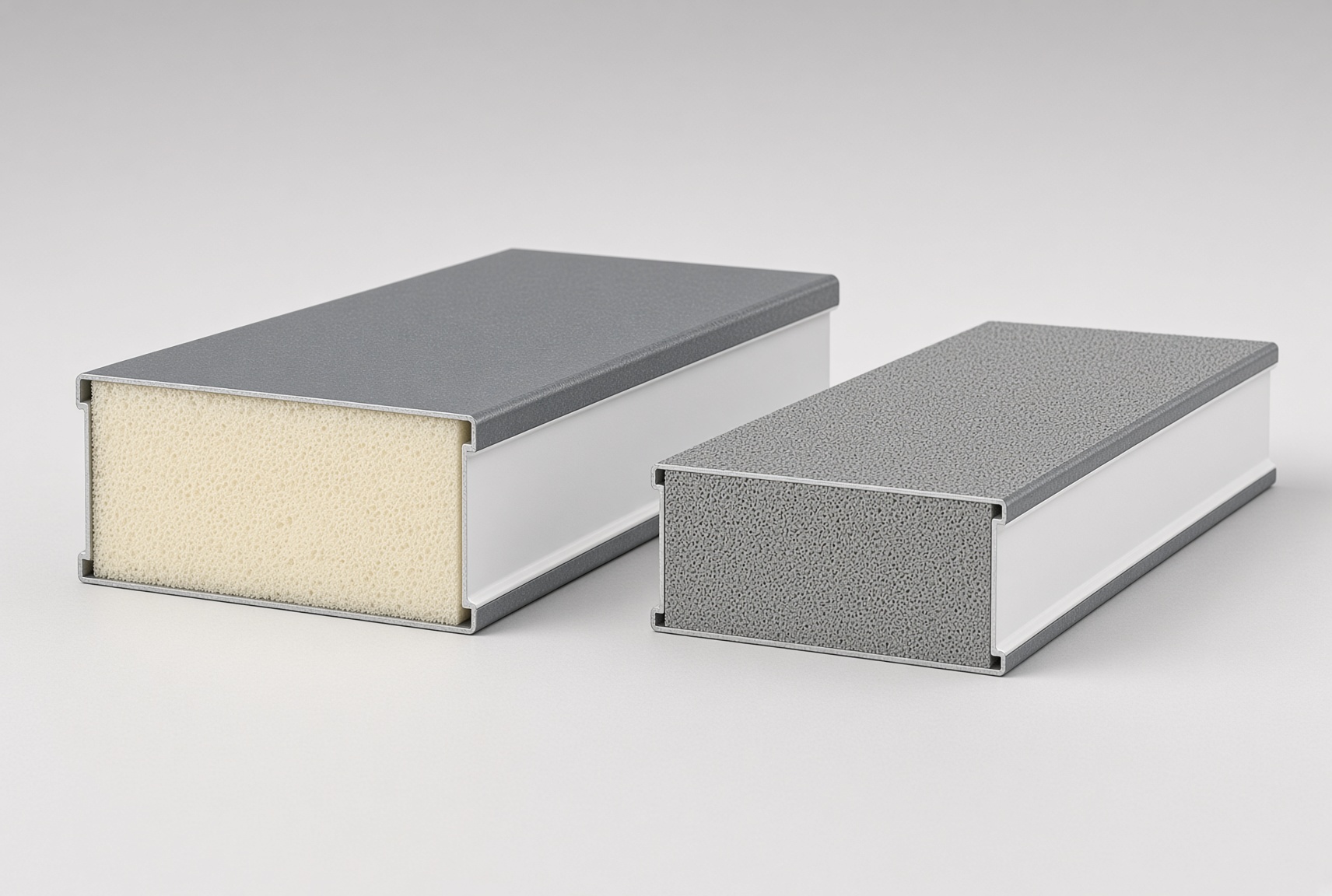
Not all insulated panels are the same. Two panels can look almost identical on the outside — steel faces, a rigid foam core, a clean factory joint — and still perform very differently once they are on your roof, wall or garden room.
The difference is the core.
A standard PIR (polyisocyanurate) panel is a good product. Kingspan QuadCore is a step beyond it. QuadCore is Kingspan’s next-generation hybrid closed-cell insulation core. It takes the strengths of PIR and improves the two things that actually decide how a building feels and costs to run: thermal performance and fire behaviour.
If you are specifying a garden room, golf simulator room, lodge, workshop, garage roof or small commercial envelope, that difference is worth understanding before you buy.
What is QuadCore — and how is it different from PIR?
PIR has been the workhorse of insulated metal panels for years. It is a closed-cell thermoset foam with solid thermal performance and far better fire behaviour than older materials such as PUR or EPS.
QuadCore is not “just another PIR”. It is a self-blended hybrid core with a distinctive grey microcell structure. That finer closed-cell structure is what delivers:
• a class-leading thermal conductivity of 0.018 W/m·K
• around 11% better thermal performance than high-quality PIR
• improved reaction to fire, with less smoke and a higher ignition temperature
• the ability to hit the same U-value with a thinner panel
In short: same family of construction, higher-performing core.
1. Better insulation in every millimetre
Thermal conductivity (lambda, λ) is the raw measure of how well a material resists heat flow. The lower the number, the better.
Typical high-quality PIR cores sit around 0.022 W/m·K. QuadCore is specified at 0.018 W/m·K. That is not a marketing rounding error. It is the reason an 80 mm QuadCore KS1000RW roof panel can achieve a U-value of 0.23 W/m²K — performance you would normally need a thicker standard PIR panel to match.
What that means on a real project:
• lower heating and cooling bills, year after year
• more stable internal temperatures in garden rooms, lodges and studios
• an easier route to Part L / Section 6 energy requirements
• the option to use a slimmer panel without giving up comfort
For a space you actually occupy — a home office, treatment room, holiday lodge or golf sim room — that extra performance shows up as comfort, not just a number on a datasheet.
2. The same U-value with a thinner panel
Because QuadCore works harder per millimetre, you often do not need as much thickness to hit the target U-value. Across the market this is commonly around 20% thinner than a standard PIR panel for the same thermal result.
A thinner panel is not just a neater detail. It changes the build:
• More internal space. Extra headroom matters in golf simulator rooms, home cinemas and compact garden rooms.
• Less weight on the structure. Lighter panels can reduce the load on purlins, rails or a timber frame and, in some cases, the amount of secondary steel.
• Less material, less transport, less waste. A slimmer core uses less foam, packs more efficiently and leaves less offcut on site.
• Cleaner detailing. Thinner walls and roofs make junctions, flashings and openings easier to resolve.
You are not buying a thinner building. You are buying the same (or better) thermal envelope in a more efficient package.
3. Stronger fire performance — and less smoke
Fire performance is where many “standard PIR” panels quietly diverge. Not all PIR is formulated or tested to the same standard.
QuadCore is designed to char rather than melt and run. In comparative core tests against EPS, PUR and non-insurer-approved PIR, QuadCore typically shows:
• a higher ignition temperature
• slower flame spread
• significantly lower smoke generation
• less heat released
That last point matters as much as flame. Smoke, not just fire, is what damages contents, triggers insurance scrutiny and makes a building unusable after an incident.
Independent classifications and insurer approvals commonly associated with QuadCore panel systems include:
• Euroclass B-s1,d0 on the internal face (EN 13501-1) — B for limited contribution to fire, s1 for the lowest smoke class, d0 for no flaming droplets
• LPS 1181 (LPCB) for sandwich panel cladding systems
• FM 4880 / 4881, and on many systems FM 4882 — the FM Global standard for smoke-sensitive occupancies. QuadCore insulated metal panels were the first closed-cell panels in the world to achieve FM 4882
Exact ratings always depend on thickness, orientation, liner and assembly. The point for a buyer is simpler: QuadCore is specified and tested to a higher fire and smoke standard than generic PIR.
For a garden room next to the house, a lodge on a holiday park, or a workshop storing tools and stock, that is not a technical nicety. It is risk management.
4. One component that actually performs as a system
A good insulated panel is not just foam between two sheets of steel. It is structure, weatherproofing, airtightness and insulation in a single factory-made component.
QuadCore KS-series panels (including the KS1000RW roof and wall panels we supply) give you:
• a weathertight envelope as soon as the panels are fixed
• a tight interlocking joint that reduces thermal bridging and air leakage
• high strength-to-weight spanning, so less secondary structure
• a durable coated steel face that needs little maintenance
• a build that can go up in cold or wet weather because it is a dry mechanical fix
Compared with a traditional multi-layer roof or timber-frame wall, you cut out separate insulation, membranes, liners and a lot of site labour. Compared with a cheaper PIR panel, you keep that speed and add a better core.
That is why the same panel family is used on industrial buildings and on our garden rooms and lodge kits. The envelope is the product.
5. Lower running costs for the life of the building
The purchase price of a panel is only the first cost. The core decides the running cost.
A tighter, higher-performing envelope:
• reduces the size and run-time of heating and cooling
• keeps holiday lodges comfortable without heating them all day
• makes a garden office usable in January without a portable heater on full
• helps the building stay closer to the U-value you designed, not just the U-value on day one
Kingspan supports QuadCore with the QuadCore Assured package on qualifying systems, including long-term thermal and fire performance cover. Always check the warranty that applies to the specific panels and project you are buying. Our own supply also carries Kingspan’s standard manufacturers’ warranty — details are on our warranty page.
Even without leaning on the warranty wording, the physics is straightforward: a lower lambda and a better joint mean less heat leaking out for decades.
6. A more responsible specification
Thinner panels for the same U-value mean less raw material and fewer lorry movements. Factory-made panels also cut site waste compared with cutting boards, membranes and liners by hand.
QuadCore cores are manufactured without CFCs, HCFCs or HFCs. Combined with a long service life and the option, on many projects, to dismantle and reuse panels if a building is relocated, that is a more circular approach than a cheap panel you replace early.
If you are building a lodge park, a workshop or a garden room you intend to keep, specifying the higher-performing core is one of the few decisions that improves both energy use and material use at the same time.
QuadCore vs standard PIR at a glance
|
|
Typical standard PIR panel |
Kingspan QuadCore panel |
|
Insulation core |
Polyisocyanurate (PIR) |
Hybrid closed-cell QuadCore |
|
Thermal conductivity (λ) |
Around 0.022 W/m·K |
0.018 W/m·K |
|
Thermal performance |
Good |
Around 11% better than high-quality PIR |
|
Thickness for a given U-value |
Thicker core needed |
Often a thinner panel |
|
Fire / smoke behaviour |
Varies widely by brand and approval |
Higher ignition point, lower smoke, B-s1,d0 (internal face, system-dependent) |
|
Insurer / large-scale testing |
Not always insurer-approved |
LPS 1181 and FM approvals, including FM 4882 on many systems |
|
Best for |
Budget envelope where minimum compliance is enough |
Garden rooms, lodges, workshops and buildings where comfort, running cost and fire performance matter |
When should you still consider a standard PIR panel?
Honesty helps specification. A quality PIR panel is still a capable product. It may be the right call if:
• the project is a basic non-habitable store and budget is the only driver
• the required U-value is modest and thickness is not constrained
• the panel is fully certified for the use, not an untested generic foam
For anything people occupy, heat, or insure properly — habitable garden rooms, studios, golf rooms, holiday lodges, offices, workshops — QuadCore is the better default. The extra performance is in the core you cannot see, which is exactly where cheap panels cut corners.
The practical takeaway
Buy the panel for the building you want in ten years, not the one that looks cheapest on a quote.
Kingspan QuadCore gives you:
1. More insulation per millimetre (λ 0.018 W/m·K)
2. A slimmer build for the same U-value
3. Better fire and smoke performance, backed by serious third-party tests
4. A faster, tighter, single-component envelope
5. Lower energy use for the life of the building
That is why we specify QuadCore across our roof panels, wall panels, garden rooms and modular lodge kits.
Ready to specify QuadCore?
Browse our Kingspan QuadCore roof and wall panels, or talk to the team about a garden room or lodge kit.
• Phone: 0808 196 9212
• Email: info@insulatedpanelstore.co.uk
• Showroom: Greenfield Business Park 2, Holywell, Flintshire, CH8 7GJ
If you tell us the span, target U-value and use of the building, we can confirm the right thickness — and show you where QuadCore lets you go thinner than a standard PIR panel without giving anything up.