




A cladding job is not finished when the last panel is fixed. It is finished when those fixings stay where they were driven.
On metal-faced insulated panels that is harder than it looks. Buildings move. Roofs and walls expand and contract with temperature. Wind, traffic and plant vibration work through the structure. Over time, many conventional fasteners start to unwind. The washer no longer compresses the seal correctly. Water finds a path. And the cladding contractor is back on site with a gun, walking the same elevations they already completed.
That callback is one of the least visible costs in envelope work — and one of the easiest to design out. Kingspan PaneLok was developed specifically for Kingspan QuadCore KS1000RW roof and wall panels, with a thread form intended to lock the fastener in place and reduce the risk of over-tightening or unwinding.
Why fasteners unwind on cladding
A panel fastener is a small component doing a large job. It has to drill, tap, clamp the outer sheet, compress a weather washer and hold that clamp force for the life of the building.
Several things work against it:
Building movement and thermal cycling. Steel and aluminium skins grow and shrink as the temperature changes. Each cycle puts a small reversing load on the thread engagement. Over years, that movement can walk a conventional screw backwards.
Vibration. Wind on a large elevation, door traffic in a distribution shed, and plant on the roof all introduce vibration. Threads that rely on friction alone can ratchet loose a fraction of a turn at a time.
Thin sheet and over-driving. The outer face of an insulated panel is a thin metal skin. There is limited material for the thread to bite. Drive too hard — especially with an impact driver — and you strip the formed thread or crush the washer. Drive short of the right compression and the seal never seats. Either way, the joint is compromised from day one.
Once preload is lost, the washer no longer does its job. That is when water ingress starts: not as a dramatic failure, but as a slow leak at fastener locations, staining, damp insulation and, eventually, a defect notice.
The real cost is not the screw. It is the return visit.
For the cladding contractor, an unwound fastener is rarely just a technical issue. It is a programme and margin issue.
Crews have to remobilise, get back on the roof or elevation, find the loose fixings and retighten them. Access equipment comes back. The main contractor wants to know why the envelope is not closed. The client sees water and assumes the panel system has failed, when the failure is often at the fixing.
Those visits eat labour, plant and goodwill. They also put people back at height on a building that should already have been signed off. If the seal has already been broken, retightening may not fully restore the weather path. Prevention is cheaper than correction.
How PaneLok is designed to stay put
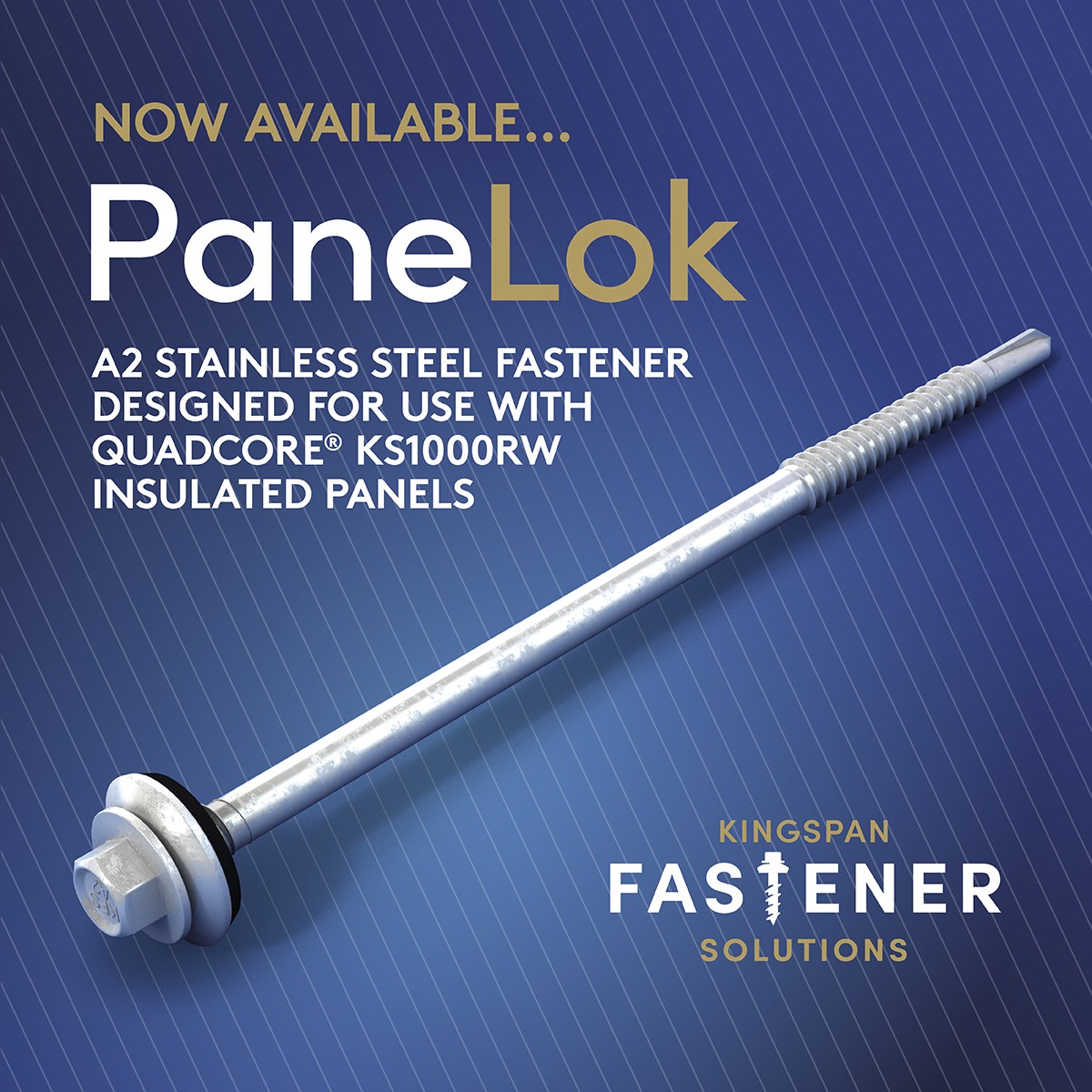
PaneLok is not a generic roofing screw specified against a panel. It is a custom A2 stainless steel primary fastener, purpose-built for Kingspan QuadCore KS1000RW insulated roof and wall panels.
Three details matter for the unwinding problem:
A unique tapered thread. The taper is designed to lock the fastener into place as it is driven, reducing the risk of both over-tightening and unwinding once the joint is made. That is the feature that addresses building movement in service, not just installation torque on the day.
A high thread that engages the outer sheet. Instead of relying only on the substrate bite, the high thread is intended to grip the panel’s outer metal face. That extra engagement helps keep clamp force on the washer and skin, which is exactly what is lost when a standard fastener starts to back out.
A domed washer with an EPDM seal. Weather tightness depends on consistent compression. The domed washer is designed to compress the EPDM in a controlled way, forming a reliable weather-tight barrier around the hole. If the fastener stays at the installed depth, the seal stays at the installed compression.
That combination is the practical answer to the contractor’s problem: fewer fasteners walking out means fewer reasons to send a crew back to retighten.
Independently assessed, not just marketed
This is not only a Kingspan product claim. The Steel Construction Institute (SCI) has assessed technical data and test results for Kingspan Fastener Solutions Multifix and PaneLok fasteners. SCI stated that the data demonstrate beneficial performance in terms of enhanced resistance to thread stripping, over-driving and unwinding in service.
That last phrase is the one that matters on a live building. Resistance to unwinding in service is what reduces the likelihood of a loose washer, a broken seal and a water path months after handover.
What this means on site
For cladding contractors, the benefit is operational:
- Fixings that are designed to hold their set, so the weather seal is more likely to remain as installed.
- Less risk of water ingress at fastener positions caused by a screw that has backed off.
- Fewer return visits to walk roofs and walls with a driver, looking for fasteners that have worked loose.
- A cleaner handover, with less snagging around leaks that appear after thermal movement has started.
PaneLok is specified for steel substrates from 1.2 mm to 3.0 mm and for KS1000RW panels from 80 mm to 137 mm thick, with a 16 mm or 19 mm aluminium and EPDM washer. Heads carry a unique stamp for identification on site.
Installation method still matters. Kingspan is explicit: use a screw gun, not an impact driver. Impact tools make it easy to over-drive, strip threads and crush washers — the same conditions that later show up as loose fixings and failed seals. A depth-stop or nosepiece and the correct speed setting keep the washer at the designed compression.
Tight on day one is not the same as tight in year five
Most fasteners can be made to look correct at installation. The test is whether they are still doing the same job after the building has moved through summer heat, winter contraction and years of wind.
Unwinding is a quiet failure. It does not announce itself until water is inside the building or a client is asking why the envelope needs attention so soon. Specifying a fastener designed to resist that movement — and assessed for unwinding in service — is one of the simpler ways to protect the panel system, the weather line and the contractor’s programme.
PaneLok will not remove the need for correct setting-out, the right number of fixings for the wind load, or a proper drive technique. What it is designed to remove is the familiar cycle of drive, wait, return and retighten.
That is the unwinding benefit: the crew finishes the elevation once.